

Solar Lighting: The Gateway to Off-Grid Energy
Solar lighting is often the first step toward energy independence. For the 600+ million people in Africa without reliable electricity and hundreds of millions more across Asia, solar lights replace dangerous kerosene lamps, expensive candles, and unreliable grid power with clean, free illumination.
The technology ranges from simple $5 lanterns to sophisticated $5,000+ street lighting systems — there's a solar lighting solution for every need and budget.
Types of Solar Lighting
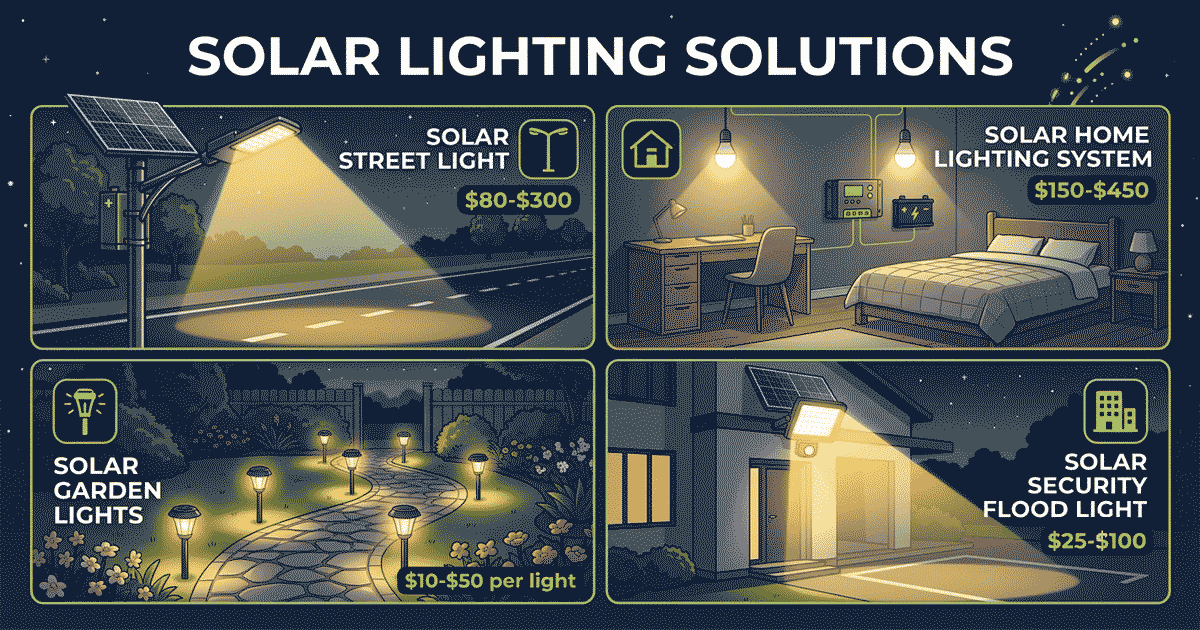
Solar Home Lighting Systems: Typically include a small solar panel (10-50W), battery, charge controller, and 3-5 LED light points. These systems provide 4-8 hours of lighting per night and often include USB charging ports for phones. Ideal for rural homes transitioning from kerosene. Price range: $30-$200.
Solar Street Lights: All-in-one or split-type systems for road, pathway, and security lighting. Modern all-in-one units integrate panel, battery, controller, and LED fixture into a single unit mounted on a pole. Light output ranges from 2,000 to 20,000+ lumens. Price range: $100-$2,000 per unit. Browse solar lighting products.
Solar Garden and Landscape Lights: Decorative and functional outdoor lighting for residential and commercial landscapes. Available in path lights, spotlights, string lights, and decorative fixtures. Typically self-contained with small integrated panels and batteries.
Solar Security and Flood Lights: High-powered LED fixtures with motion sensors for security applications. Modern units offer 50-200W equivalent lighting with motion detection, dusk-to-dawn operation, and remote control via smartphone apps.
What to Look for When Sourcing Solar Lights
LED quality: Look for brand-name LED chips from manufacturers like Bridgelux, Cree, or Osram. Cheap LEDs degrade rapidly, losing 30-50% brightness within the first year.
Battery type: LiFePO4 batteries last 5-8 years versus 1-2 years for cheap lithium-ion cells. Always verify the battery chemistry — it's the most common cost-cutting area.
Controller intelligence: Smart controllers with time-based dimming can extend runtime by 50-100%. Full brightness during peak hours, reduced brightness during quiet hours — saving battery without sacrificing safety.
IP rating: IP65 minimum for outdoor installations. IP67 or IP68 for flood-prone areas or coastal environments with salt spray.
Frequently Asked Questions
How many solar street lights do I need per kilometer of road?
Typically 25-35 lights per kilometer, depending on road width and required illumination level. For standard rural roads, lights spaced 30-40 meters apart with 50W LED fixtures provide adequate visibility. Urban roads with higher standards may require 20-25 meter spacing with higher-powered fixtures.
Do solar lights work during monsoon season?
Quality solar lights with properly sized batteries maintain 2-3 nights of autonomy, covering most monsoon cloudy periods. However, extended weeks of heavy cloud cover will reduce runtime. System sizing should account for your location's worst-case solar conditions.
What is the lifespan of solar street lights?
Quality units last 8-12 years overall. LED modules last 50,000+ hours (15+ years at 10 hours/night). LiFePO4 batteries last 5-8 years. The solar panel lasts 20+ years. Budget for battery replacement at year 6-8 to maintain optimal performance.