

Understanding Solar Panel Technology
Choosing between monocrystalline and polycrystalline solar panels is one of the first decisions you'll face when building an off-grid solar system. Both technologies convert sunlight into electricity, but they differ in efficiency, cost, appearance, and performance under various conditions.
Monocrystalline Solar Panels
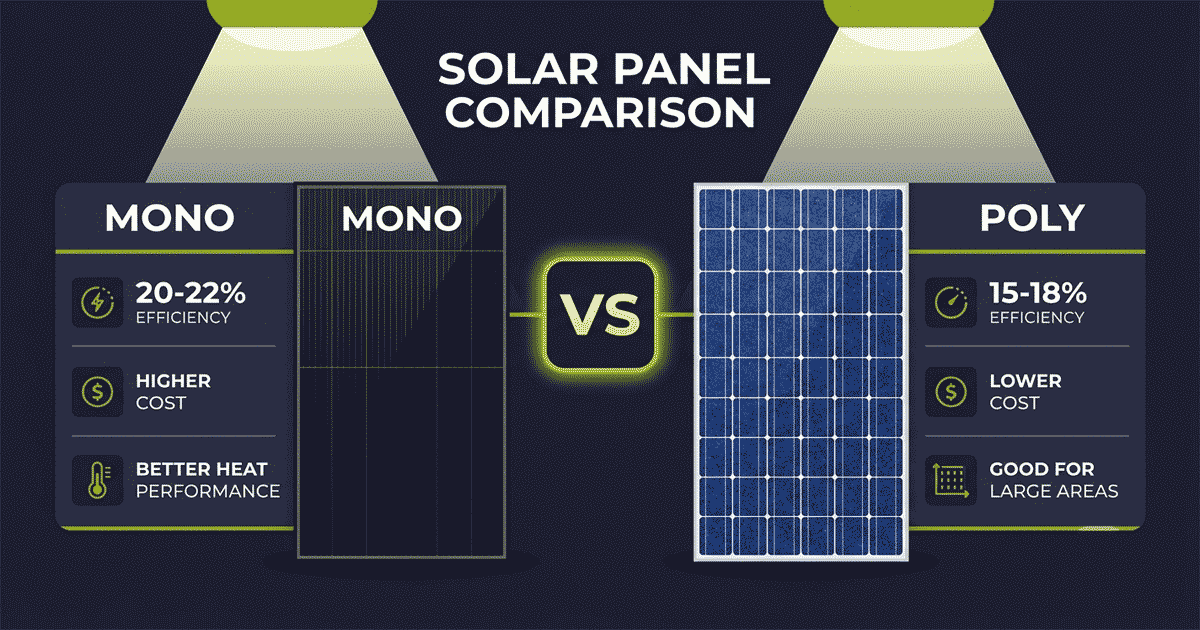
Monocrystalline panels are made from single-crystal silicon, giving them a uniform dark appearance and the highest efficiency ratings among conventional panel types.
Efficiency: 20-22% for standard panels, with premium models reaching 23-24%. This means more power per square meter of roof or ground space.
Performance in heat: Better temperature coefficient means less efficiency loss in hot climates — important for tropical regions across Asia and Africa.
Lifespan: Typically warranted for 25-30 years with less than 0.5% annual degradation.
Best for: Limited installation space, high-efficiency requirements, hot climates, and long-term installations.
Polycrystalline Solar Panels
Polycrystalline panels are made from multiple silicon crystals, giving them a distinctive blue speckled appearance. They're manufactured using a simpler process, resulting in lower costs.
Efficiency: 15-18% for standard panels. While lower than mono, this is sufficient for many off-grid applications where space isn't a constraint.
Cost advantage: Typically 10-20% cheaper than equivalent monocrystalline panels, making them attractive for budget-conscious projects.
Lifespan: 25-year warranties are standard, though degradation rates are slightly higher than monocrystalline.
Best for: Large ground-mounted systems, budget-sensitive projects, moderate climates.
Head-to-Head Comparison for Off-Grid Use
For off-grid applications specifically, several factors tip the balance:
Space efficiency: If your roof or mounting area is limited, monocrystalline panels generate more power per square meter, reducing the number of panels needed and the mounting hardware required.
Low-light performance: Monocrystalline panels perform marginally better in overcast conditions and during early morning or late afternoon — critical for maximizing off-grid production hours.
Total system cost: While poly panels are cheaper per watt, the total system cost difference narrows when you factor in mounting hardware, wiring, and installation labor for additional panels.
Our Recommendation
For most off-grid installations in 2026, monocrystalline panels offer the best long-term value. The efficiency advantage means fewer panels, less mounting hardware, and better performance across seasons. However, for large ground-mounted arrays where space isn't a constraint, polycrystalline panels can deliver excellent value.
Browse our complete solar panel catalog from verified manufacturers, or request a quote for your specific project requirements.
Frequently Asked Questions
Are monocrystalline panels worth the extra cost?
For most off-grid applications, yes. The higher efficiency means fewer panels, less wiring, and reduced mounting costs. Over a 25-year lifespan, the additional upfront cost is typically recovered within 2-3 years through higher energy production.
Do polycrystalline panels work in hot climates?
Yes, but they lose slightly more efficiency in high heat compared to monocrystalline panels. In tropical regions where temperatures regularly exceed 35°C, monocrystalline panels maintain better performance.
Can I mix monocrystalline and polycrystalline panels?
Technically possible but not recommended. Different panel types have different electrical characteristics. Mixing them on the same string reduces overall system efficiency. If you must mix, use separate charge controllers for each panel type.