

The Battery Decision: Your Most Important Investment
Batteries represent 40-50% of a typical off-grid solar system's cost and are the component that most affects daily living experience. The right battery choice determines how much power you have at night, how long your system lasts, and your long-term cost of energy.
In 2026, the two main contenders are Lithium Iron Phosphate (LiFePO4) and Lead-Acid batteries (including AGM and Gel variants). Here's how they compare for off-grid solar applications.
LiFePO4 (Lithium Iron Phosphate) Batteries
LiFePO4 has become the dominant choice for new off-grid installations in 2026, and for good reason.
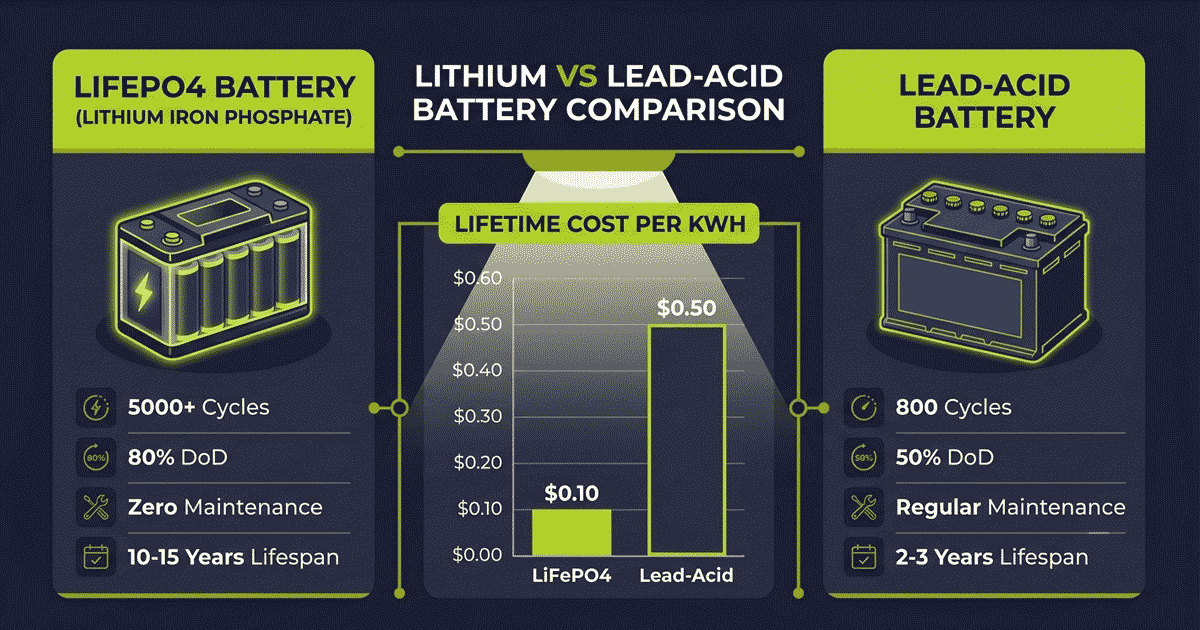
Cycle life: 5,000-7,000 cycles at 80% depth of discharge. At one cycle per day, that's 13-19 years of service life.
Depth of discharge: Can safely use 80-90% of rated capacity without damage, meaning a 10 kWh battery delivers 8-9 kWh of usable energy.
Weight: Approximately 50% lighter than equivalent lead-acid batteries — critical for rooftop installations and portable systems.
Efficiency: 95-98% round-trip efficiency means less energy lost during charge and discharge cycles.
Maintenance: Zero maintenance required. No watering, no equalization charges, no terminal cleaning.
Safety: LiFePO4 is the safest lithium chemistry — no thermal runaway risk, no toxic gases, no fire hazard under normal conditions.
Lead-Acid Batteries (AGM, Gel, Flooded)
Lead-acid technology has powered off-grid systems for decades and remains relevant for specific use cases.
Cycle life: 500-1,200 cycles depending on type (flooded, AGM, or gel) and depth of discharge. At one cycle per day, that's 1.5-3.5 years.
Depth of discharge: Should not exceed 50% to preserve battery life, meaning a 10 kWh battery delivers only 5 kWh of usable energy.
Upfront cost: 40-60% cheaper per kWh of rated capacity than LiFePO4. However, when you factor in usable capacity and lifespan, the math changes dramatically.
Maintenance: Flooded batteries require regular watering and equalization charges. AGM and gel are sealed but still need periodic inspection.
True Cost Comparison: The Math That Matters
The upfront price tells only part of the story. Let's compare the cost per kWh delivered over the battery's lifetime:
LiFePO4 example: A 10 kWh battery costing $4,000 delivers 8 kWh usable capacity × 5,000 cycles = 40,000 kWh lifetime delivery. Cost per kWh: $0.10.
Lead-acid example: A 10 kWh battery bank costing $2,000 delivers 5 kWh usable × 800 cycles = 4,000 kWh lifetime delivery. Cost per kWh: $0.50. Plus you'll need to replace it 4-5 times to match the LiFePO4 lifespan, totaling $8,000-$10,000.
The conclusion is clear: LiFePO4 costs 5x less per kWh delivered over its lifetime despite the higher upfront price.
When Lead-Acid Still Makes Sense
Lead-acid batteries remain viable for very small systems (under 500Wh), seasonal or occasional-use installations (weekend cabins), ultra-tight budgets where the upfront cost difference is the deciding factor, and backup-only systems that rarely cycle.
Our Recommendation
For any off-grid system that will be used daily, LiFePO4 is the clear winner in 2026. The higher upfront cost pays for itself within 2-3 years through longer life, deeper discharge capability, and zero maintenance. Browse our battery catalog for options from certified manufacturers.
Frequently Asked Questions
Can I replace my lead-acid batteries with LiFePO4?
Yes, but you may need to update your charge controller settings or replace it entirely. LiFePO4 batteries require different charging parameters than lead-acid. Consult your system documentation or contact our team for compatibility guidance.
Are LiFePO4 batteries safe for indoor installation?
Yes. Unlike other lithium chemistries, LiFePO4 produces no toxic gases and has no thermal runaway risk. They're safe for indoor installation in a well-ventilated area, making them ideal for residential off-grid systems.
How cold is too cold for LiFePO4 batteries?
Most LiFePO4 batteries should not be charged below 0°C (32°F), though they can discharge at lower temperatures. Many modern units include built-in heating systems for cold-climate installations. This is rarely an issue in tropical regions where off-grid demand is highest.