

Why Off-Grid Solar Is Booming in 2026
The global shift toward energy independence has accelerated dramatically. With electricity costs rising across Asia, Africa, and Latin America, and grid reliability remaining a challenge in rural areas, off-grid solar systems have become the practical choice for millions of homes and businesses worldwide.
Whether you're powering a rural home in Bangladesh, a farm in Kenya, or a remote business in the Philippines, choosing the right off-grid solar system requires understanding your energy needs, budget, and long-term goals.
Key Components of an Off-Grid Solar System
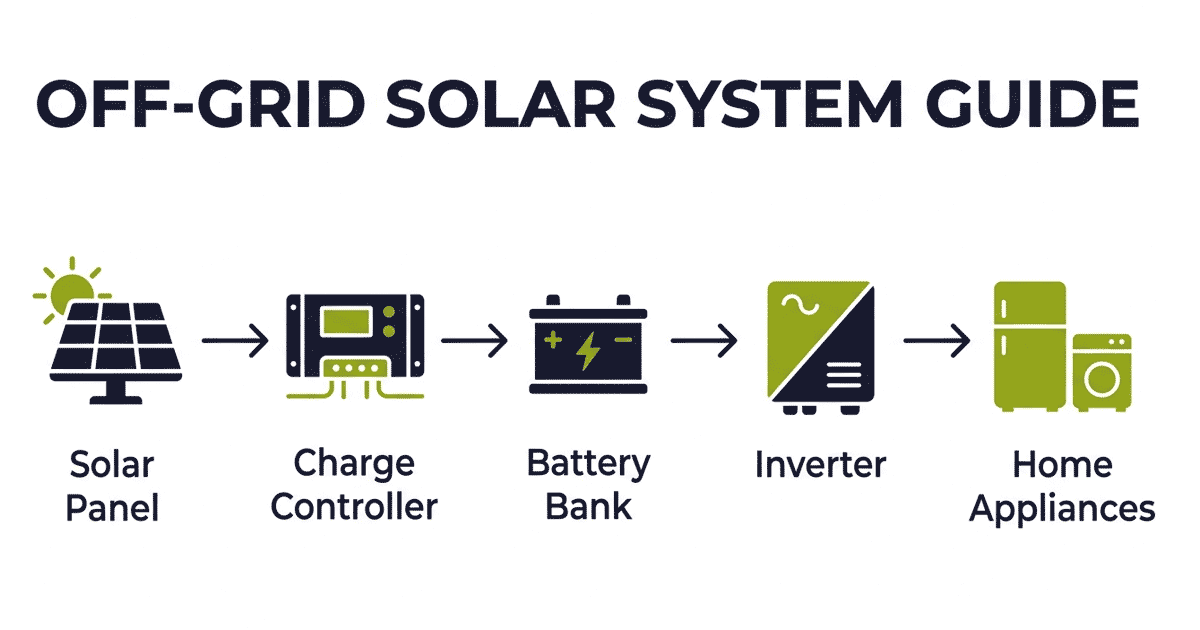
Every off-grid solar system consists of four essential components that work together to generate, store, and deliver electricity:
Solar Panels capture sunlight and convert it into DC electricity. For off-grid applications, monocrystalline panels offer the highest efficiency, typically converting 20-22% of sunlight into usable power. Browse our solar panel catalog for options from verified manufacturers.
Charge Controllers regulate the flow of electricity from panels to batteries, preventing overcharging and damage. MPPT controllers are 15-20% more efficient than PWM alternatives, making them the preferred choice for systems above 200W. View charge controllers.
Battery Storage stores energy for use when the sun isn't shining. Lithium Iron Phosphate (LiFePO4) batteries have become the standard in 2026, offering 5,000+ charge cycles compared to 500-800 cycles for traditional lead-acid batteries. Explore battery options.
Inverters convert DC battery power into AC electricity for your appliances. For off-grid systems, look for pure sine wave inverters that can handle your peak load requirements. Compare inverters.
How to Size Your Off-Grid Solar System
Proper sizing is the most critical step. An undersized system leaves you without power; an oversized system wastes money.
Step 1: Calculate your daily energy consumption. List every appliance, its wattage, and daily usage hours. A typical rural home uses 3-5 kWh per day, while a small business might need 8-15 kWh.
Step 2: Determine your solar panel capacity. Divide your daily consumption by the peak sun hours in your location (typically 4-6 hours). Add a 25% buffer for system losses. For a 5 kWh daily need with 5 sun hours, you'd need approximately 1,250W of panels.
Step 3: Size your battery bank. Plan for 2-3 days of autonomy (cloudy days). For 5 kWh daily use with 2 days autonomy, you need 10 kWh of usable battery capacity. With lithium batteries at 80% depth of discharge, that's a 12.5 kWh battery bank.
Step 4: Select your inverter. Choose an inverter rated for your peak load plus a 20% margin. If your highest simultaneous load is 2,000W, select a 2,500W inverter minimum.
Cost Considerations in 2026
Off-grid solar costs have dropped significantly. A basic home system (1-2 kW) ranges from $1,500 to $3,500 depending on battery chemistry and panel quality. Larger systems (5-10 kW) for homes or small businesses range from $8,000 to $20,000.
The key cost driver is batteries, typically representing 40-50% of total system cost. However, lithium battery prices fell approximately 20% between 2024 and 2026, making complete systems more affordable than ever.
Choosing the Right Manufacturer
Quality varies dramatically in the solar market. Look for manufacturers with ISO 9001 certification, IEC 61215 panel certification, and verifiable warranty programs. At OffGridPrime, we connect you directly with verified manufacturers, ensuring quality and competitive pricing.
Frequently Asked Questions
How long does an off-grid solar system last?
Solar panels typically last 25-30 years with minimal degradation. Lithium batteries last 10-15 years (5,000+ cycles). Inverters and charge controllers generally last 10-15 years. The system as a whole provides decades of reliable power with periodic component replacement.
Can an off-grid solar system power an entire house?
Yes, a properly sized system can power a complete household including lights, fans, refrigerator, TV, phone charging, and small appliances. High-consumption items like air conditioning and electric cooking require larger, more expensive systems.
What happens during cloudy days or monsoon season?
Battery storage provides power during low-sunlight periods. A well-designed system includes 2-3 days of battery autonomy. For extended cloudy periods, a backup generator can supplement solar production. System sizing should account for your location's worst-case solar conditions.
Is off-grid solar cheaper than grid electricity?
In areas with high electricity costs or unreliable grids, off-grid solar achieves payback within 3-7 years. In remote areas where grid connection costs $5,000-$50,000+ per kilometer, off-grid solar is immediately more economical.