

What Does a Charge Controller Do?
A solar charge controller sits between your solar panels and batteries, regulating voltage and current to ensure safe, efficient battery charging. Without one, your panels would overcharge and destroy your batteries within weeks. It's a small component with an outsized impact on system performance and battery lifespan.
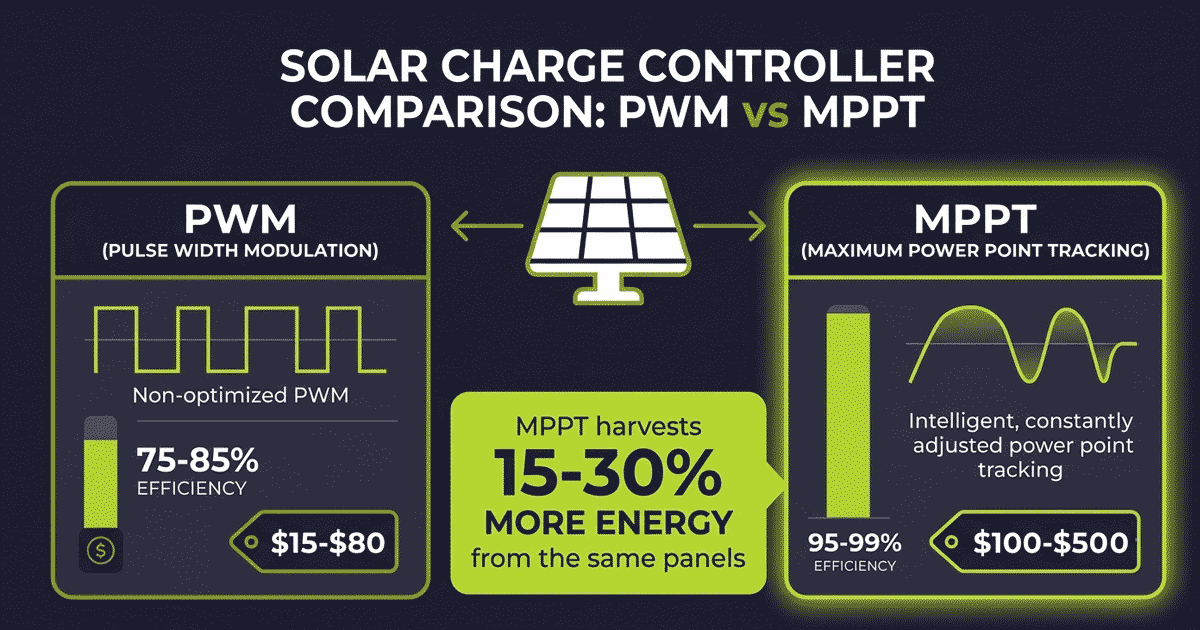
The two technologies available are PWM (Pulse Width Modulation) and MPPT (Maximum Power Point Tracking). Understanding the difference can mean 15-30% more energy harvested from the same solar panels.
PWM (Pulse Width Modulation) Controllers
PWM controllers are the simpler, more affordable option. They work by directly connecting the solar panel to the battery and rapidly switching the connection on and off to regulate charging voltage.
How it works: PWM essentially 'clips' the panel voltage down to the battery voltage. If your panel produces 18V but your battery needs 14.4V, the excess 3.6V is wasted as heat.
Efficiency: 75-85% of available solar energy is captured.
Cost: $15-$80 for most residential sizes.
Best for: Small systems under 200W, 12V battery systems where panel voltage closely matches battery voltage, and budget installations.
MPPT (Maximum Power Point Tracking) Controllers
MPPT controllers are intelligent devices that optimize the electrical relationship between panels and batteries using DC-DC conversion.
How it works: MPPT continuously adjusts its input to find the voltage at which your panels produce maximum power, then converts that to the optimal charging voltage and current for your battery. It's like an automatic transmission versus a fixed gear.
Efficiency: 95-99% of available solar energy is captured — that's 15-30% more than PWM from the same panels.
Higher voltage panels: MPPT allows you to use higher voltage panel strings (e.g., 60V or 72V panels) with 12V or 24V battery banks. This means longer wire runs with less voltage drop — ideal for ground-mounted arrays far from batteries.
Cost: $100-$500 for residential sizes.
Best for: Systems above 200W, 24V or 48V battery banks, installations where panels are far from batteries, and any system where maximizing production justifies the cost.
The 15-30% Difference in Practice
For a 1,000W solar array, an MPPT controller harvests an additional 150-300Wh per day compared to PWM. Over a year, that's 55-110 kWh of additional energy — enough to power LED lighting for months. The extra energy is most pronounced in cold weather, partial shading, and during morning and evening hours when panel voltage is furthest from battery voltage.
Making the Right Choice
For any off-grid system above 400W, MPPT is the obvious choice. The additional $50-$200 cost pays for itself within months through increased energy harvest. For small portable or camping systems under 200W, PWM controllers are perfectly adequate and keep costs minimal. Browse our charge controller selection.
Frequently Asked Questions
Can I upgrade from PWM to MPPT without changing my panels?
Yes. Simply replace the controller and update the wiring if needed. Your existing panels will immediately produce more usable energy with an MPPT controller. No other system changes required.
Does MPPT work better in cloudy conditions?
Yes. MPPT controllers continuously track the optimal power point, which shifts significantly under cloud cover. PWM controllers cannot adapt, losing a higher percentage of available energy during overcast conditions.
What size MPPT controller do I need?
Size your MPPT controller based on both maximum input voltage (total panel string voltage) and maximum charge current (total panel wattage divided by battery voltage). Always check the controller's specifications against your panel array configuration.