

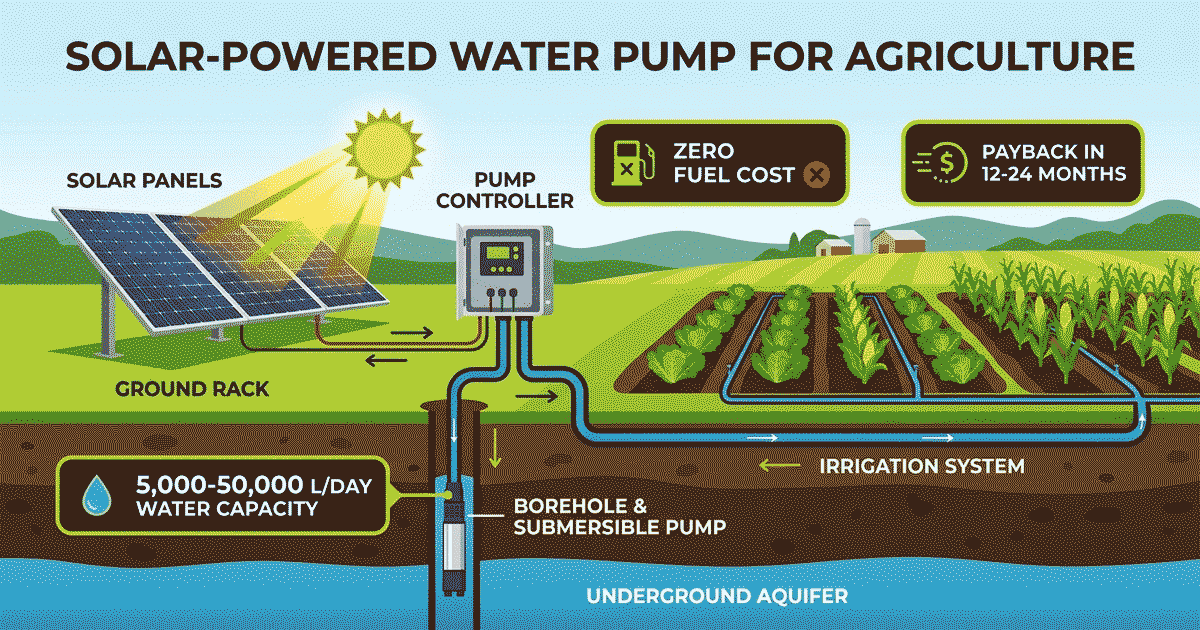
Why Solar Water Pumps Are Transforming Agriculture
For farmers in off-grid regions across Asia, Africa, and Latin America, solar water pumps have eliminated one of agriculture's biggest constraints: reliable access to water without diesel fuel costs. A solar pump system typically pays for itself within 1-2 growing seasons through eliminated fuel costs alone.
The technology is mature, proven, and increasingly affordable. Global installations of solar irrigation pumps exceeded 500,000 units in 2025, with India, Bangladesh, Kenya, and Nigeria leading adoption.
Types of Solar Water Pumps
Submersible pumps are installed inside boreholes or deep wells. They can lift water from depths of 30-200+ meters and are the most common choice for groundwater irrigation. Typical flow rates range from 2,000 to 50,000 liters per day depending on depth and solar array size.
Surface pumps draw water from rivers, ponds, lakes, or shallow wells (up to 8 meters suction depth). They're simpler to install and maintain, making them ideal for canal-based irrigation systems.
Floating pumps sit directly on the water surface of ponds or reservoirs. They require no suction pipe and are easy to relocate between water sources.
How to Size a Solar Pump System
Step 1: Determine your daily water requirement in liters. For drip irrigation, a typical small farm (1-2 acres) needs 5,000-15,000 liters per day. Flood irrigation requires significantly more.
Step 2: Measure your total dynamic head (TDH) — the vertical distance the water must be lifted plus friction losses in the piping. A 50-meter borehole with 100 meters of horizontal piping might have a TDH of 55-60 meters.
Step 3: Select a pump rated for your flow and head requirements. Manufacturers provide performance curves showing flow rate at different head pressures.
Step 4: Size the solar array. Most pump manufacturers specify the minimum panel wattage for each pump model. A typical submersible pump for 50-meter depth requires 1,000-2,000W of panels.
Key Features to Look For
When sourcing solar water pumps, prioritize: MPPT controller (built-in or external) for maximum efficiency, dry-run protection to prevent damage when water levels drop, stainless steel or corrosion-resistant construction for longevity, and a manufacturer warranty of at least 2-3 years on the motor and pump assembly.
Cost and ROI
A complete solar pump system for small-scale agriculture ranges from $500 to $3,000 depending on depth, flow rate, and panel size. Compared to diesel pumps costing $2-$5 per day in fuel, the solar system typically achieves full payback within 12-24 months. After payback, the water is essentially free for 15-20+ years.
Browse our solar water pump catalog or request a quote for agricultural pump systems.
Frequently Asked Questions
Can solar pumps work during monsoon or rainy seasons?
Yes, though at reduced capacity. On cloudy days, a solar pump may produce 30-60% of its sunny-day output. Many farmers install storage tanks to buffer water supply during extended cloudy periods. Some systems include battery backup for cloudy-day operation.
What maintenance do solar water pumps require?
Solar pumps require minimal maintenance compared to diesel alternatives. Clean the solar panels monthly, inspect wiring connections annually, and check the pump for sediment buildup every 6-12 months. No oil changes, no fuel procurement, no engine maintenance.
How long do solar water pumps last?
Quality submersible solar pumps last 8-15 years. The solar panels typically last 25+ years. The inverter/controller may need replacement after 10-15 years. Overall, a well-maintained system provides 15-20 years of service.