

The Opportunity
The off-grid solar market is one of the fastest-growing sectors in clean energy. With annual growth rates exceeding 25% in Africa and Asia, and global off-grid solar revenue projected to reach $10 billion by 2028, there has never been a better time to enter the solar distribution business.
Unlike many industries, solar distribution can be started with relatively modest capital. A focused operation — targeting a specific product category or geographic area — can launch with $5,000-$20,000 in inventory and grow organically from revenue.
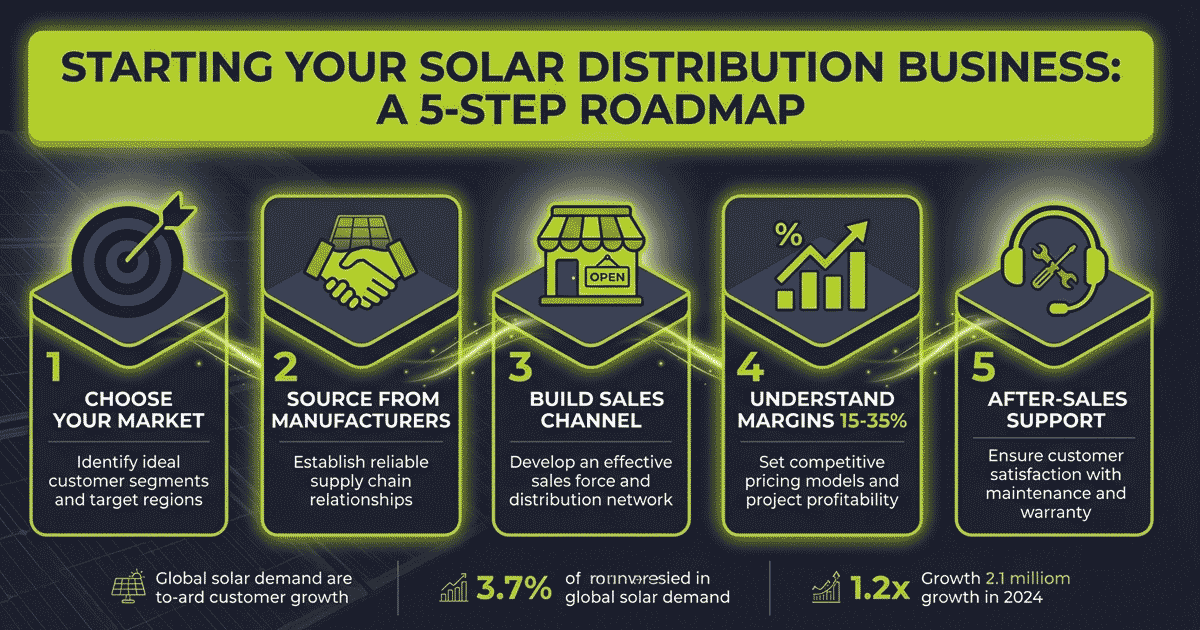
Step 1: Choose Your Market and Niche
Don't try to sell everything to everyone. Successful solar distributors typically specialize in a product category (solar home systems, street lights, pumps, or complete systems), a geographic territory (a specific region, country, or city), or a customer segment (residential, agricultural, commercial, or government).
Research your local market: How many people lack reliable electricity? What's the current cost of energy alternatives (diesel, kerosene, grid)? What competitors already exist? What products are in demand but unavailable locally?
Step 2: Source From Verified Manufacturers
Product quality will make or break your business. A single batch of defective panels or batteries can destroy your reputation and customer trust permanently.
This is where platforms like OffGridPrime add critical value. We connect distributors directly with ISO-certified, IEC-compliant manufacturers who have verified track records. No middlemen, no quality uncertainty. Register as a dealer to access our manufacturer network.
Step 3: Build Your Sales Channel
Effective channels for off-grid solar products include direct B2B sales to installers, contractors, and project developers, retail through your own showroom or partner shops, government and NGO tenders for rural electrification projects, and online sales through your own website and marketplaces.
In developing markets, demonstration and education are crucial. Most customers are buying solar for the first time and need to see and understand the product before purchasing.
Step 4: Understand Your Margins
Typical distributor margins in off-grid solar range from 15-35% depending on product category and market. Solar panels carry lower margins (15-20%) due to commodity pricing. Batteries and controllers offer better margins (20-30%). Complete systems and installation services provide the highest margins (25-40%).
Step 5: Provide After-Sales Support
After-sales service is your competitive moat. Offer installation guidance or service, warranty support and easy replacement processes, customer education on system maintenance, and technical sizing assistance for new projects. The businesses that thrive long-term are those that customers trust for ongoing support, not just one-time sales.
Frequently Asked Questions
How much capital do I need to start a solar distribution business?
A focused operation can start with $5,000-$10,000 for initial inventory. Larger operations with showroom space and multiple product lines may require $20,000-$50,000. Many manufacturers offer credit terms to established distributors, reducing upfront capital requirements after the initial orders.
Do I need technical knowledge to sell solar products?
Basic understanding of solar system sizing and components is essential. Many manufacturers offer free training programs for their distributors. You don't need to be an engineer, but you need to confidently answer customer questions about system sizing, performance, and compatibility.
How do I find reliable solar product manufacturers?
Browse verified manufacturers on OffGridPrime or contact our sourcing team with your specific product requirements. We verify certifications, production capacity, and quality control processes before listing manufacturers on our platform.