

Why Your Inverter Choice Matters
The inverter is the brain of your off-grid solar system. It converts DC electricity from your batteries into AC power that runs your appliances. A poor inverter choice means inefficiency, equipment damage, or system failure. A good choice means reliable, clean power for decades.
Types of Inverters for Off-Grid Systems
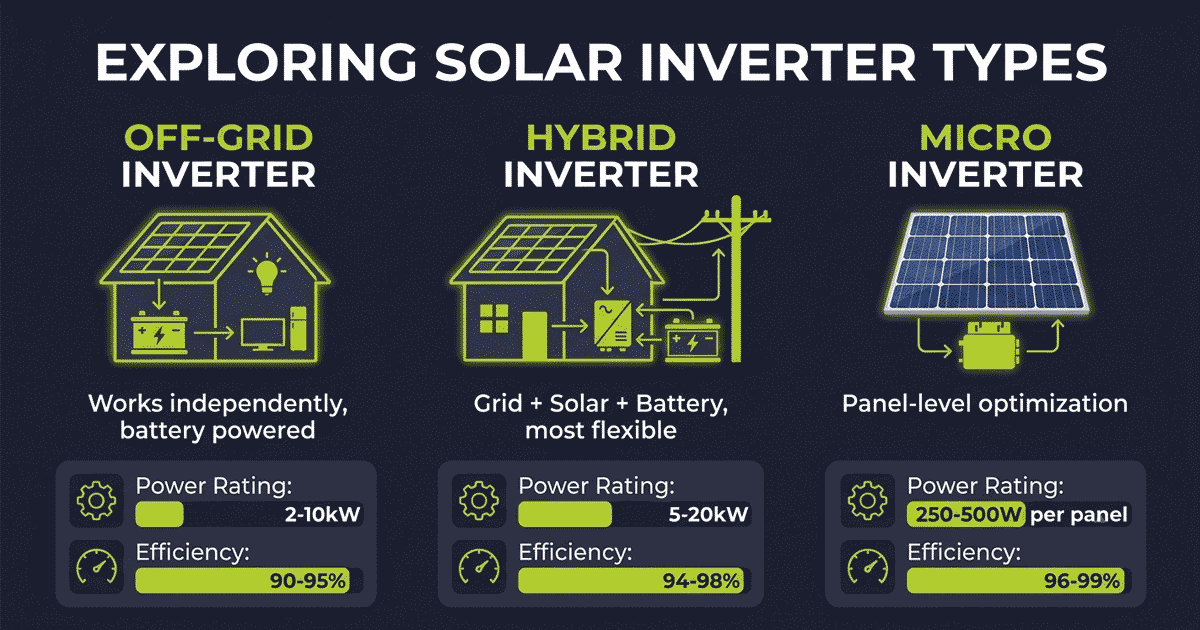
Off-Grid (Standalone) Inverters are designed to work independently without any grid connection. They draw power exclusively from batteries and provide stable AC output. These are the standard choice for remote locations with no grid access. Key features include built-in battery charger (for generator integration), automatic transfer switch, and programmable battery management. View our inverter catalog.
Hybrid Inverters can work both off-grid and grid-tied. If the grid is available, they can use it as backup or sell excess solar production back to the utility. If the grid goes down, they automatically switch to off-grid mode. Hybrid inverters are the most popular choice in 2026 because they provide flexibility — start off-grid today, connect to grid later if it becomes available.
Micro Inverters are small inverters attached to individual solar panels. While primarily used in grid-tied systems, some off-grid configurations use micro inverters with AC-coupled battery systems. They offer panel-level optimization but add complexity and cost to off-grid setups.
Key Specifications to Evaluate
Continuous power rating: Must exceed your maximum simultaneous AC load. A typical home needs 3,000-5,000W continuous. Remember that some appliances (refrigerators, pumps, power tools) draw 3-5x their rated power during startup.
Surge capacity: Should handle 2x continuous rating for motor starts. A 5,000W inverter should handle 10,000W surges for at least 5 seconds.
Wave form: Always choose pure sine wave for off-grid systems. Modified sine wave inverters are cheaper but can damage sensitive electronics, produce buzzing in audio equipment, and reduce motor efficiency.
Efficiency: Look for 93-97% conversion efficiency. At 5 kWh daily consumption, the difference between 90% and 96% efficiency saves over 100 kWh per year.
Sizing Your Inverter
List your highest simultaneous load in watts, add 25% safety margin, then select the next size up. For a household with maximum simultaneous load of 2,500W: 2,500 × 1.25 = 3,125W → select a 3,500W or 5,000W inverter. It's always better to oversize slightly than undersize.
Frequently Asked Questions
Can I run an air conditioner on an off-grid inverter?
Yes, but you need a properly sized system. A typical 1.5-ton AC unit draws 1,200-1,800W continuously and may surge to 4,000-5,000W at startup. You'll need a minimum 5,000W inverter with strong surge capability, plus adequate solar and battery capacity to support the load.
What's the difference between 12V, 24V, and 48V inverter systems?
Higher voltage systems (48V) are more efficient for larger installations because they carry the same power at lower current, reducing wire size requirements and energy losses. 12V systems are suitable for small loads under 1,000W. 24V works for 1,000-3,000W. 48V is recommended for systems above 3,000W.
How long do solar inverters last?
Quality off-grid inverters last 10-15 years with proper installation and ventilation. Key factors affecting lifespan include operating temperature (keep below 40°C), dust protection, and avoiding sustained overloading.